Geography
Welcome to Geography:
Subject Coordinator: Mrs Herring
At Bramhope Primary School, our geography lessons inspire pupils to be inquisitive and curious about the world and everyone who shares it.
Our curriculum equips pupils with knowledge about the human and physical geography of Bramhope and Yorkshire. Pupils also learn about the features of contrasting countries, their people, resources and natural and physical environments.
Geography includes practical fieldwork. We explore our school grounds and local area using maps, diagrams and aerial photographs and children maintain virtual connections with children in our link school in Uganda. The aim of this fieldwork is to ignite a fascination and investment in our local and global community which will last long after pupils leave our school.
What makes Geography different at Bramhope?
Geography at Bramhope reflects our whole school vision and motto: Belong, Be your best, Be Bramhope.
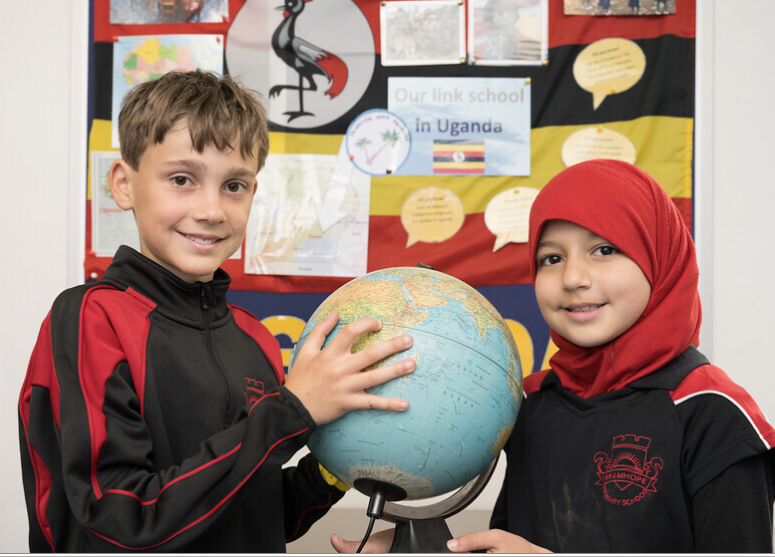
Belong: From the very start of our pupils’ journey at Bramhope, we teach them that they belong to our school and our local community. This is done through our EYFS unit All About Me, our KS1 unit Our Local Area and our KS2 unit Yorkshire and the UK. We then extend pupils’ knowledge so they can begin to understand the wider world and our global community. One of the ways we do this is through our link school Way of Salvation Primary in Uganda. This special link gives our children insight into another country and the lives of others on a personal level.
Be your best: Children are challenged through open-ended tasks and discussions. They are given the skills needed to become increasingly independent as they progress through school. We provide opportunities for children to present their work in different formats to showcase their knowledge, understanding and skills. Examples of this could be: creating a tourist brochure or documentary; creating a river collage showing the various stages of a river; creating messy maps out of classroom materials.
Be Bramhope: We are fortunate to have access to a wonderful outdoor space which provides rich opportunities for fieldwork. Our village is also undergoing significant changes (such as the building of a new housing development) and we are studying these changes as part of the ‘Our local area’ unit. We are also near an international airport, so we discuss how connected we are to destinations around the world. Reception visit Nell Bank to understand their part in looking after our environment through taking part in the ‘Tidy’ programme. Additionally, as part of our vision to develop young leaders, our school has a Y6 Eco-Council. These children are passionate about doing their bit to reduce waste and pollution.
What are lessons like?
The geography curriculum is carefully planned so that teachers are building on pupils’ prior learning and knowledge. Each lesson focuses on developing locational knowledge, place knowledge, human and physical geography and/or geographical skills and fieldwork.
Geography is taught at Bramhope as stand-alone lessons. We have three units per year, which link closely with our history units. Cross-curricular links are often made with maths, science, RE and English. For example, the KS2 unit on Migration combines elements of geography and history. Classroom lessons are enriched through fieldwork. Within the classroom, children learn through:
- Practical and investigative activities
- Discussing geography in the news and using local examples where possible
- Questioning in order to deepen pupils’ understanding and challenge their findings.
- Researching tasks in order to answer questions and develop knowledge of maps, atlases, and key texts
- Speaking to visitors in order to give pupils first-hand experience
What do we mean by progress?
Progress in all subjects is measured through a child’s ability to know more, remember more, and explain more.
Geography units have been sequenced carefully to aid progression of knowledge. Our geography long-term plans clearly show prior learning and future learning so that all teachers know what has come before and what will come after. This allows teachers to talk to children about links that they can make with previous years and the future. We are developing knowledge sentences for children to help them remember the essential knowledge in geography. For information, click on the links for the knowledge overviews below.
What do we mean by assessment?
We use light-touch formative assessment throughout the year, being precise about the knowledge and skills that are identified as most significant and worth recording.
We do this by:
- Starter questions
- Questioning in class
- Open-ended tasks
- Mind maps
- Double page spreads at the end of topics to showcase knowledge
Teachers use frequent retrieval practice to inform decisions about planning, determining whether whole-class, small group or individual teaching is needed and when to move on to new learning.
At the end of a unit, assessment tasks can be used to showcase the children’s knowledge and understanding. Tasks can take the form of double-page spreads, mind maps, debates, or creative tasks such as making posters.